
There's a Formula for Regime Change?!?
Regime change is known to happen through an extremely small percentage of people

I have been thinking a lot about what is to come.
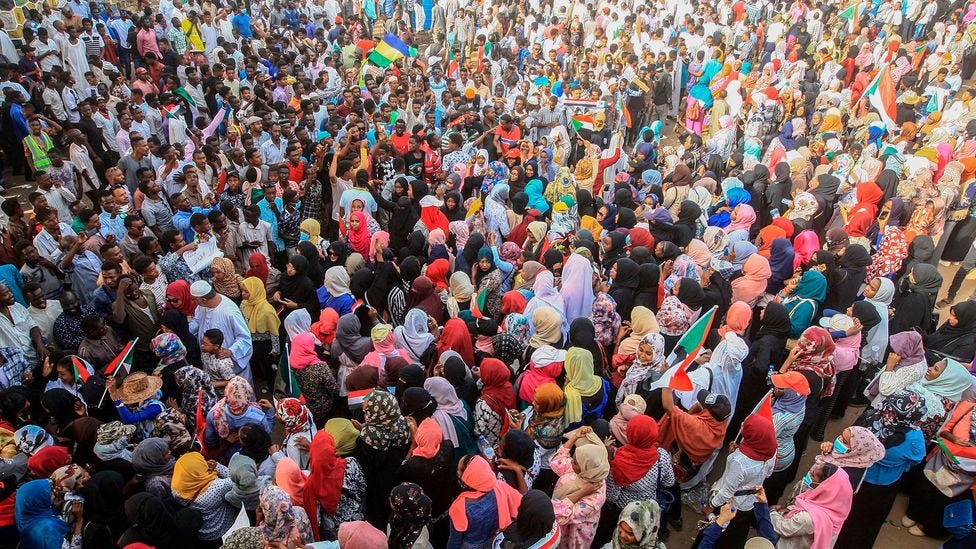
As I watch millions of world citizens gathering to peacefully protest in their own countries for various reasons, I see very little of it in America.
Why is that?
Because, by in large, we’re fat and happy.
Figuratively and often literally.
Not all of us.
But most of us.
We’re still comfortable.
But, my guess, is that is about to change.
I anticipate some dramatic things will happen that will steadily increase our discomfort.
The Bad Guys have been hijacking our food sources. Food processing plants and farms are being blown up and/or set ablaze. Chemical spills are poisoning farmland. Supply chains are being severely disrupted because of our dependence on foreign imports, including some foods.
Great.
Just great.
We’re entering a season where I believe we’ll be seeing the destruction of MANY more food sources of ours for a reason you may not have thought of yet: Our beloved White Hats are fighting this war on myriad fronts. I believe that they are now tracking the movements of the cabal’s efforts in poisoning our food sources and will disrupt that strategy by removing the sources prior to distribution through pre-emptive destruction. Farm crops and food processing plants will be destroyed in greater and greater numbers—some by the Bad Guys, trying to kill us—and some by the Good Guys, trying to protect us.
Let’s add a layer of runaway inflation on top of all that.
I believe we’re going to get increasingly less comfortable about our food supply, in both its safety and its availability.
How about gasoline and diesel prices? In my home state of Arizona, gas is now over five dollars a gallon.
Crazy.
America’s truckers deliver our supply chain all across America. What happens when the trucking businesses can no longer afford fuel to be profitable? After all, they’re NOT non-profit businesses.
What happens when a family’s breadwinner has to make decisions on a limited income? Do you buy a tank of gas, put exorbitantly priced food on the table, or pay the rent to keep a roof over your head?
The decisions will continue to get harder and harder.
And then there’s the money supply. I think we can all agree that, at some point, the fiat dollar will go bye-bye and the masses will freak out.
There are LOTS of ways we’re about to get uncomfortable.
So back to the topic at hand: Exactly what needs to happen to usher in regime change?
I’ve been digging around, looking at “revolutions” that have happened over the last hundred years or so and have been wondering if there was any rhyme or reason to the “tipping points” that started revolutions.
Along the way, I ran into a really interesting BBC article, The '3.5% rule': How a small minority can change the world. And it really encouraged me.
If you can join me in putting aside your disgust for the BBC and jumping to the conclusion that the information in the article might have some potentially directional merit, there are some really interesting findings.
The article discusses the research of Erica Chenoweth, a political scientist at Harvard University, who comprehensively compared the success rates of nonviolent versus violent protests. Her research confirmed that “civil disobedience is not only the moral choice; it is also the most powerful way of shaping world politics – by a long way.”
Here’s the description about the study (published in 2011) from Columbia University Press’s sales page to buy the book (bold and italics are mine):
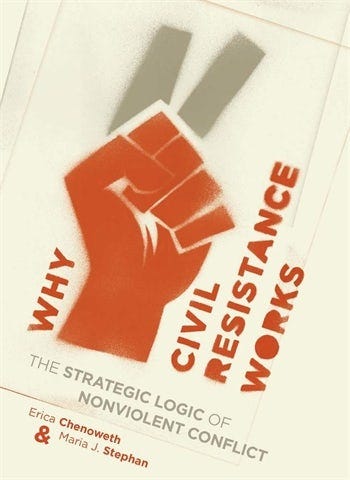
For more than a century, from 1900 to 2006, campaigns of nonviolent resistance were more than twice as effective as their violent counterparts in achieving their stated goals. By attracting impressive support from citizens, whose activism takes the form of protests, boycotts, civil disobedience, and other forms of nonviolent noncooperation, these efforts help separate regimes from their main sources of power and produce remarkable results, even in Iran, Burma, the Philippines, and the Palestinian Territories.
Combining statistical analysis with case studies of specific countries and territories, Erica Chenoweth and Maria J. Stephan detail the factors enabling such campaigns to succeed and, sometimes, causing them to fail. They find that nonviolent resistance presents fewer obstacles to moral and physical involvement and commitment, and that higher levels of participation contribute to enhanced resilience, greater opportunities for tactical innovation and civic disruption (and therefore less incentive for a regime to maintain its status quo), and shifts in loyalty among opponents' erstwhile supporters, including members of the military establishment.
Chenoweth and Stephan conclude that successful nonviolent resistance ushers in more durable and internally peaceful democracies, which are less likely to regress into civil war. Presenting a rich, evidentiary argument, they originally and systematically compare violent and nonviolent outcomes in different historical periods and geographical contexts, debunking the myth that violence occurs because of structural and environmental factors and that it is necessary to achieve certain political goals. Instead, the authors discover, violent insurgency is rarely justifiable on strategic grounds.
What are some of the examples of successful nonviolent resistance movements? I found many of these to be extremely interesting.
In 2019, the presidents of Sudan and Algeria both announced they would step aside after decades in office, thanks to peaceful campaigns of resistance.
In 2003, the people of Georgia ousted Eduard Shevardnadze through the bloodless Rose Revolution, in which protestors stormed the parliament building holding the flowers in their hands.
The consumer boycotts in apartheid-era South Africa, in which many black citizens refused to buy products from companies with white owners, caused an economic crisis among the country’s white elite that contributed to the end of segregation in the early 1990s.
The Singing Revolution was a series of events in 1987–1990 that led to the restoration of independence of the three then Soviet-occupied Baltic countries of Estonia, Latvia, and Lithuania at the end of the Cold War.
In 1986, millions of Filipinos took to the streets of Manila in peaceful protest and prayer in the People Power movement. The Marcos regime folded on the fourth day.
Prayer. Flowers. Singing. Boycotts. Strikes. There are many peaceful options.
Interesting.
Here’s the punch line from the study, folks.
Once around 3.5% of the whole population has begun to participate actively, success appears to be inevitable. “There weren’t any campaigns that had failed after they had achieved 3.5% participation during a peak event,” says Chenoweth – a phenomenon she has called the “3.5% rule”.
If we calculate 3.5% of our approximately 330 million population in America, that means only 11,550,000 of us need to organize to achieve success!
How encouraging is THAT?
More encouragement from the study:
Nonviolent campaigns are more likely to succeed because they can recruit many more participants from a much broader demographic, which can cause severe disruption that paralyses normal urban life and the functioning of society.
Perhaps most obviously, violent protests necessarily exclude people who abhor and fear bloodshed, whereas peaceful protesters maintain the moral high ground.
Nonviolent protests also have fewer physical barriers to participation. You do not need to be fit and healthy to engage in a strike, whereas violent campaigns tend to lean on the support of physically fit young men. And while many forms of nonviolent protests also carry serious risks – just think of China’s response in Tiananmen Square in 1989 – Chenoweth argues that nonviolent campaigns are generally easier to discuss openly, which means that news of their occurrence can reach a wider audience. Violent movements, on the other hand, require a supply of weapons, and tend to rely on more secretive underground operations that might struggle to reach the general population.
By engaging broad support across the population, nonviolent campaigns are also more likely to win support among the police and the military – the very groups that the government should be leaning on to bring about order.
Now we just need a flame to light the match.
My guess is that ONE thing will happen that will light that match INSTANTLY in the hearts and minds of all Americans. There will be ONE tipping point to move Americans into the streets to say ENOUGH.
What does a nationwide protest need to be successful? Well, if we look at some of the examples cited above …
Heart
Simplicity
Emotion
Prayer
Focus
Commitment
Americans typically have an abundance of all of those characteristics, so we’re halfway there!
Friends, I just stand in awe that God decided to have me live RIGHT HERE, RIGHT NOW to experience THIS season in history. That’s not a mistake for me—nor for you.
Did you know that the Bible says, “From one man he made all the nations, that they should inhabit the whole earth; and he marked out their appointed times in history and the boundaries of their lands.” (Acts 17-26)
Did you catch that? The LORD GOD ALMIGHTY, the Maker of Heaven and Earth, The King of Kings and LORD of Lords, decided to put you HERE, NOW.
No mistakes. Planning. Destiny.
That’s pretty cool.
I, for one, am READY for a regime change!
Aren’t you?
Get yer dancin’ shoes on!
And GIDDY UP!
I am with you all the way......May The Lord Continue to Bless You.
The Old Man
I love this, Kitty! It's a glorious time to be alive!